US Pharm. 2012;37(3):12-15.
Diaper rash is a multi-factorial condition that is extremely uncomfortable for the infant and can cause a great deal of anxiety for parents. To further compound the problem, while true diaper rash (also known as irritant diaper dermatitis) is fairly simple to recognize and treat, diapers can worsen such dermatologic disorders as seborrheic dermatitis, psoriasis, and atopic dermatitis.
Manifestations of Diaper Rash
Diaper rash generally presents as a bright red irritation on the scrotum and penis in boys and on the labia and vagina in girls.1 It includes a wide range of dermatoses, such as scaling, blistering, ulcers, large bumps, pimples, or purulent sores. Children who are able to do so may scratch the area during diaper changes. If the area exhibits a beefy-red appearance, if there are small red bumps at the outer edges of the affected area, or if the child cries violently when urine touches the skin, candidal colonization is likely and a physician referral is mandatory.2,3
Safe Treatment of Diaper Rash
Obviously, infants are very vulnerable to dangerous chemicals applied to the skin. This is especially true considering that the diaper is an occlusive dressing, enhancing absorption of any topically applied, pharmacologically active ingredient. Additionally, the skin of the infant with diaper rash is often damaged or broken, further increasing the extent of absorption. For this reason, only the safest and most thoroughly investigated ingredients have been approved as protectants. Some protectants are chemically inert, but all cover and protect skin surfaces. They provide a mechanical barrier to exclude irritants, exclude or remove wetness, and protect skin that contacts opposing skin (intertriginous skin).2
The FDA’s general instructions for skin protectant products include advice to discontinue their use and seek physician care if symptoms persist for more than 7 days, and to change wet and soiled diapers promptly, cleansing the diaper area and allowing it to dry.2 Another reliable federal Web site recommends seeking physician care if the area worsens or is not completely healed in 2 to 3 days, a safer time limit.1 Parents are also advised to apply the ointment, cream, or powder liberally as often as necessary, with each diaper change, and especially at bedtime or anytime when exposure to wet diapers may be prolonged. For powder products, parents are further instructed to apply powder close to the body but away from the child’s face, and to carefully shake the powder into the diaper or into the hand and apply to the diaper area.
Specific Protectant Ingredients
If the infant’s skin is broken, the parent should be advised to see a physician.2 However, if the irritation is limited to inflammation, protectants are safe and effective. Allantoin (0.5%-2%), calamine (1%-25%), dimethicone (1%-30%), and kaolin (4%-20%) are all safe protectants.2 Cod liver oil (5%-13.56%) is also safe and effective, but it has an unpleasant smell, so it is combined with other ingredients to prevent this odor. Lanolin 15.5% is safe and effective, but it should be avoided as it is a contact sensitizer.2,4 Products containing lanolin include A+D Original Ointment, Weleda Baby Calendula Baby Cream, Belli Baby Protect Me Diaper Rash Cream, and Grandma El’s Diaper Rash Remedy & Prevention.
Mineral oil (50%-100%) is a safe and effective emollient protectant for diaper rash. It is water-insoluble, giving it a barrier effect. However, it remains on the skin indefinitely until physically removed, and may build up on the skin if not periodically cleansed away.2 Since the FDA directs the caregiver to cleanse the diaper area with each diaper change, mineral oil should not accumulate. However, if patients fail to cleanse the baby properly, it could cause chronic skin irritation and folliculitis. It is the active ingredient in Johnson’s Baby Oil.
Zinc oxide (25%-40%) pastes and ointments are safe and effective for diaper rash, but in higher concentration they are difficult to remove from the baby’s skin due to their thick and adherent nature. It is the major active ingredient in such products as Desitin Paste Maximum Strength (40% zinc oxide) and A+D Diaper Rash Cream (10%).
Petrolatum (30%-100%) is the ideal diaper rash protectant. It is virtually nonallergenic, lacks an unpleasant odor, is easily removed from the skin, and is effective as a single ingredient without the potential for folliculitis or irritation.2 It is the single active ingredient in Vaseline Petroleum Jelly and Vaseline Baby.
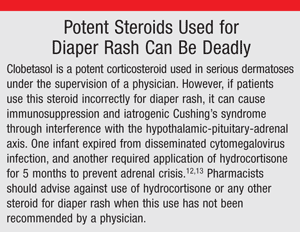
Cornstarch (10%-98%) is formulated as a powder. It is widely believed to be a safe infant powder, but it may be hazardous. In one such case, a 1-month-old infant was brought to an emergency room because of poor eating habits and impaired breathing.5 The physicians ordered a chest x-ray, which revealed diffuse opacification in both lungs, with dark-blue polygon-shaped crystals visible on a Gram-stain. The crystals were eventually demonstrated to be cornstarch. The mother admitted that she used cornstarch powder during diaper changes. The physicians diagnosed cornstarch pneumonitis, cautioning that the careless use of the powder could lead to accidental aspiration with subsequent severe respiratory disease.
Another concern about cornstarch is that it may serve as a culture medium for Candida albicans.6 Because of this, the pharmacist should recommend against the use of cornstarch. Products containing cornstarch include Johnson’s Baby Pure Cornstarch with Magnolia Petals. The magnolia petals in this product are not approved for use as protectants. The National Institutes of Health (NIH) recommends against use of cornstarch at any time as it can worsen a diaper rash with candidal infection.1
Talc (45%-100%) was once thought to be safe and effective as an absorbent in preventing and treating diaper rash, but it can be dangerous in the form of talcum powder if not used appropriately and must never be recommended.1 Products containing talcum powder include Johnson’s Baby Powder. Talcum powder presents respiratory and dermatologic risks to the baby. Accidental inhalation can be deadly, a fact of which at least 42% of mothers (of infants under the age of 2 years) are completely unaware.7,8 In one study of episodes of inhalation of talcum powder, 55% of the victims were under 1 year of age, and 41% were in their second year.7,8
In some of the worst cases cited by the FDA, one child developed aspiration pneumonia, and another required several days on a respirator.8 In an atypical case, a 3-year-old sibling poured talcum powder into the mouth and nose of a 1-month-old, who required resuscitation for cardiopulmonary arrest, but did survive. Another child of 22 months played with talcum powder, inhaling sufficient dust to produce respiratory distress and perioral cyanosis. After 20 hours of care, he expired of intractable cardiopulmonary failure.8
This issue was of such great concern to the FDA that a public meeting was held in 1994 to discuss the safe use of talcum powder in consumer products.9 Of special interest was a study by the National Toxicology Program that exposed rodents to talcum powder, finding that there was a risk of chronic pulmonary damage and death. The FDA requires a mandatory warning on products containing talcum powder to help minimize the danger of aspiration: “Keep powder away from child’s face to avoid inhalation, which can cause breathing problems.”8
Talcum powder presents dermatologic dangers to infants. If it is applied to broken skin, talcum powder can cause crusting, infection, and skin granulomas. For this reason, products containing talcum powder must carry the warning, “Do not use on broken skin.” Diaper dermatitis treated only with powders may not resolve adequately. In one such case, a 6-month-old infant with mild diaper dermatitis treated only with powders developed granulomatous tissue on the buttocks, perhaps as a result of the use of dusting powders.10
The pharmacist should advise against use of talcum powder as a skin protectant because of its dermatologic and respiratory dangers, as recommended by the NIH.1 If parents purchase the product in spite of this advice, they should be cautioned to take care in application as warned by the FDA, but the parent or caregiver should further be cautioned to keep the products stored away from children, much as poisons are stored. These precautions apply specifically to talcum powder, but can be generalized to the use of all powders in infants, regardless of the ingredients.
Unknown Ingredients in Diaper Rash Products
Diaper rash products are available under a large number of well-known brands (e.g., Vaseline, Desitin, A+D, Johnson’s), but also as a host of strangely named, obscure products.11 Some of the former and many of the latter load their products with ingredients of unknown safety and efficacy for diaper rash. They often include multiple plant-derived ingredients, which could be allergenic or toxic if absorbed. It is advisable to avoid these overloaded formulations in favor of those containing a single safe and effective protectant (e.g., petrolatum).
Boric acid is known to present dangers to babies, but it is included in such products as Boudreaux’s Butt Paste.2 Nonfat dry milk and goat’s milk are inexplicably included in such products as The First Years Bottom Care Diaper Rash Relief System and Canus Li’l Goat’s Milk Ointment. Tea tree oil is found in Bum Boosa Bamboo Diaper Rash Ointment and California Baby Non-Burning & Calming Diaper Area Wash. Although they also contain zinc oxide, miscellaneous plant ingredients are found in Aveeno Baby Soothing Relief Diaper Rash Cream, Aveeno Baby Organic Harvest Diaper Rash Cream, Balmex Diaper Rash Cream, and Puristics Baby Zinc Oxide Diaper Rash Cream.11
Some parents may ask about the use of topical antifungals for diaper rash. It is true that broken skin under the diaper is often colonized with Candida, but a physician appointment is mandatory.2 Currently available nonprescription antifungals are only indicated for fungal conditions such as tinea pedis, tinea cruris, and tinea corporis. Their efficacy on Candida is unknown.
PATIENT INFORMATION
Choosing the Right Type of Diaper
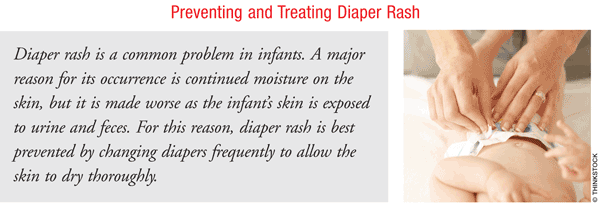
Diaper rash can cause a great deal of discomfort for the baby. Since the goal is to keep the skin dry, parents should choose diapers that are labeled as superabsorbent or ultra-absorbent. These prevent diaper rash better than older, regular absorbency diapers. Some parents prefer cloth diapers for reasons of economics, sanitation, or conservation, but disposables are far better than reusable cloth diapers in preventing diaper rash. If cloth diapers are used, they should never be covered by plastic pants, since the plastic keeps moisture trapped inside the diaper and makes diaper rash more likely.
During an active case of diaper rash, the skin is very sensitive. Most commercial diaper wipes should be avoided during this time, as these products may contain chemicals that irritate the skin affected by the rash. Immediate cleaning of the area with mild soap is the safest alternative.
Skin Protectants
Skin protectants are the safest ingredients for treating diaper rash. These include such ingredients as allantoin, calamine, cod liver oil, dimethicone, kaolin, lanolin, mineral oil, petrolatum, talc, topical starch (also known as cornstarch), white petrolatum, and zinc oxide. However, some of these are better than others. Petrolatum (e.g., Vaseline) is an excellent choice.
Powders containing kaolin, cornstarch, or talc can cause problems if the baby’s skin is broken or wounded and should be avoided. If you choose to use them anyway, keep any powder diaper rash product well away from the child’s face while you are putting it on your hands or applying it to the baby’s bottom. If you allow the powder to get into the air, the baby will inhale it while breathing, potentially producing chemical pneumonia that can lead to permanent breathing problems or death.
The best way to apply powders is to go to a location away from the baby. Place the container close to your body and away from your face. Gently shake a small amount of powder onto a hand. When the powder has settled, approach the baby and apply it to the diaper area. Never let an older sibling play with the powders either by themselves or around the baby for the same reasons.
Products to Avoid
Some chemicals should never be used on the baby. Do not use homemade preparations such as baking soda since their safety would be questionable. Any product containing boric acid or borax is unsafe and must be avoided. Chemicals such as aloe vera, benzyl alcohol, castor seed, Peruvian balsam, nonfat dry milk, arnica, borage, thymol, calendula, rose hip oil, and tea tree oil are not FDA-approved protectants. Some may be listed as inactive ingredients, but could still cause allergic reactions or other problems. Antibiotic ointments containing such ingredients as neomycin, polymyxin, or bacitracin should not be used for diaper rash. Hydrocortisone products should not be used without a physician recommendation. You should not use any antifungal or anticandidal products on diaper rash.
Remember, if you have questions, Consult Your Pharmacist.
REFERENCES
1. Diaper rash. MedlinePlus. www.nlm.nih.gov/medlineplus/ency/article/000964.htm. Accessed January 30, 2012.
2. Pray WS. Nonprescription Product Therapeutics. 2nd ed. Baltimore, MD: Lippincott Williams & Wilkins; 2006.
3. Rash—child under 2 years. MedlinePlus. www.nlm.nih.gov/medlineplus/ency/article/003259.htm. Accessed January 30, 2012.
4. Kligman AM. Lanolin allergy: crisis or comedy. Contact Dermatitis. 1983;9:99-107.
5. Silver P, Sagy M, Rubin L. Respiratory failure from corn starch aspiration: a hazard of diaper changing. Pediatr Emerg Care. 1996;12:108-110.
6. Farrington E. Diaper dermatitis. Pediatr Nurs. 1992;18:81-82.
7. Preston SL, Bryant BG. Etiology and treatment of diaper dermatitis. Hosp Pharm. 1994;29:1086-1088,1097.
8. Skin protectant drug products for over-the-counter human use; proposed rulemaking for diaper rash drug products. Fed Regist. 1990;55:25204-25232.
9. Talc; consumer uses and health perspectives; public meetings. Fed Regist. 1994;59:2319.
10. Konya J, Gow E. Granuloma gluteale infantum. Australas J Dermatol. 1996;37:57-58.
11. Diaper rash products. www.drugstore.com. Accessed February 7, 2012.
12. Semiz S, Balci YI, Ergin S, et al. Two cases of Cushing’s syndrome due to overuse of topical steroid in the diaper area. Pediatr Dermatol. 2008;25:544-547.
13. Tempark T, Phatarakijnirund V, Chatproedprai S, et al.
Exogenous Cushing’s syndrome due to topical corticosteroid application:
case report and review literature. Endocrine. 2010;38:328-334.
To comment on this article, contact rdavidson@uspharmacist.com.