US Pharm. 2012;37(8):12-15.
Tick-borne diseases are the most common vector-borne diseases in North America.1 Public awareness of Rocky Mountain spotted fever (RMSF) and Lyme disease is fairly high, but there are numerous additional tick-borne diseases that remain obscure to the public. Occasionally, pharmacists may suspect that a patient has contracted a tick-borne disease, and subsequently refer the patient to a physician. The patient may deny having been bitten. In these cases, it is vital to inform patients that it is common to not notice a feeding tick because the bite is often painless.2
The situation is made more difficult by the nonspecific nature of many of the signs and symptoms of tick-borne diseases. Fever, chills, fatigue, malaise, myalgia, and headache each have long and complicated differential diagnoses. Tick bites are a remote possibility, so that a good number of patients are undiagnosed and untreated for a considerable period while the infection continues to cause damage that may be permanent.
Rocky Mountain Spotted Fever
RMSF is caused by Rickettsia rickettsii, transmitted by Rocky Mountain wood ticks, American dog ticks, and brown dog ticks.1,2 RMSF has been reported in nearly every state. The classic symptoms consist of fever (of abrupt onset) and a rash that begins on the palms, soles, wrists, and forearms, spreading to the trunk, neck, and face. Patients also suffer headache, abdominal pain, anorexia, malaise, myalgias, red eyes, nausea, and vomiting.2 If the patient’s infection was severe, long-term health problems are likely. They include vasculitis, clotting in the brain or other organs, impaired circulation to the extremities requiring amputation, severe neurologic deficits, and damage to the internal organs. The disease may be fatal in just 8 days if untreated.2 Prompt doxycycline administration often yields excellent results. Pharmacists who suspect RMSF should refer the patient immediately so that care can be instituted.
Lyme Disease
The pharmacist should be alert to the possibility of Lyme disease in a patient with a recent history of tick bite.1 Lyme disease is caused by a spirochete (Borrelia burgdorferi ) that is transmitted by the bite of the blacklegged tick.1,3 While the first U.S. cases were clustered around Lyme, Connecticut, the condition has been diagnosed in patients in 49 states. Symptoms of Lyme disease include a characteristic rash, known as erythema migrans (a nonpruritic, erythematous, painless maculopapular ring with a defined border and perhaps a clear center, described as a “bulls-eye”) and a nonspecific flulike illness causing malaise, fatigue, lethargy, headache, fever, chills, stiff neck, sore throat, arthralgias, myalgias, anorexia, nausea, and a malar rash.1,3 The bite site may necrose, resembling a brown recluse spider bite.
Patients must be referred to a physician for immediate care; delay can increase the risk of debilitating conditions as the infection spreads to the heart, joints, and nervous system. However, appropriate and prompt antibiotic therapy (e.g., doxycycline, amoxicillin, cefuroxime) can prevent sequelae.3
Other Tick-Borne Diseases
A less well-known U.S. tick-borne disease is anaplasmosis.4 Several species of adult ticks bite humans and transfer the bacterium Anaplasma phagocytophilum. Symptoms, which begin about 7 to 14 days postbite, usually include one or more of the following: fever, chills, headache, myalgia, malaise, nausea, abdominal pain, confusion, and rash (rarely).4 The CDC stresses that doxycycline is the drug of choice for all patients and must be initiated immediately, confirming the importance of pharmacist referral.
Babesiosis is a tick-transmitted parasitic condition that may be life-threatening for a patient whose spleen is absent or hypoactive, whose immune system is weak, who is elderly, or who has serious underlying health conditions.5 In these cases, infection can cause hypotension, hemolysis, thrombocytopenia, and other deadly sequelae. CDC-suggested treatment regimens include atovaquone, azithromycin, clindamycin, and quinine.5
Several Rickettsial bacteria transmitted by ticks cause a condition known as ehrlichiosis, producing fever, chills, nausea, headache, fatigue, and myalgia.6,7 Less commonly, the patient experiences diarrhea, petechial rash, maculopapular rash, and malaise. Doxycycline is also the medication of choice for ehrlichiosis.
Southern tick-associated rash illness (STARI) is the name given to a lone star tick-borne condition whose cause has not yet been identified, but which produces fatigue, fever, headache, and muscle or joint pains.8 A red bull’s-eye lesion develops around the tick bite, expanding to 3 inches or more (similar to the Lyme disease lesion). Medications used for Lyme disease may provide relief.8
Tick-borne relapsing fever (TBRF) is a bacterial infection attacking those who sleep in cabins in the mountains where rodents are plentiful.9 Treatments include penicillins, other beta-lactam antibiotics, tetracyclines, macrolides, and fluoroquinolones.9
Tularemia is a tick-borne bacterial infection with symptoms that vary, but treatment options include streptomycin, gentamicin, tetracycline, and ciprofloxacin.10
Tick Repellents
This month’s Patient Information provides tips on dressing to prevent tick bites in tick-infested areas. Pharmacists can also advise patients on the use of insect repellents as further deterrents to bites. Insect repellents must be registered with the Environmental Protection Agency (EPA) prior to marketing, assuring they are safe and effective; the EPA has published many consumer-oriented informational sheets on the topic.11-16 The only two products proven safe and effective for humans when used properly are DEET and picaridin. There is no minimum age of use mandated by the EPA. Therefore, unless the product label has a specific age restriction, the products are safe for patients of all ages. Human-use insect repellents do not repel head lice. Further, they should not be used on pets.
DEET 4%-100%: DEET repels mosquitoes, ticks, and chiggers, as well as several biting flies and gnats, when applied to skin or clothing.1,12 While DEET is safe for the majority of users, pharmacists should advise patients to follow the numerous guidelines to minimize toxicity.1,12 Toxic reactions include altered mental state, paresthesias, hallucinations, agitation, incoherence, and aggressive and belligerent behavior.13 There is no age restriction on DEET, and no percentage restriction for children.
To prevent toxicity, DEET must be used sparingly, with just enough to cover exposed skin and clothing.1,12,14 Patients should not exceed the suggested times of application. If the labeled application regimen is every 8 hours, the product should not be applied more frequently. DEET should not be used beneath clothing (e.g., under a diaper in babies or under the shirt in adults), as application to an occluded area can increase absorption. It should never be overapplied, especially using frequent total-body applications. It should not be applied to abrasions, cuts, wounds, or irritated skin. Following application, the patient should avoid swimming, toweling the skin, or situations that would cause sweating. All of these remove DEET and tempt the patient to reapply sooner than suggested. Children should not be allowed to use the product themselves, and it should not be applied near a child’s eyes and mouth. DEET should not be placed on parts of the child’s body that enter the mouth, such as fingers and thumbs.
Patients should wash the skin thoroughly with soap and water after they return indoors, and they should not wear treated clothing until it has been laundered. If the DEET product is a pump or aerosol spray, patients must take care not to inhale misted product and never to spray it in enclosed areas or toward the face. Rather, they should spray it on the hands and rub it on the face, avoiding the area around the eyes. DEET is widely available in pharmacies, with some examples being the OFF! and Repel product families.
Picaridin 5%-20%: Picaridin is the only other EPA-registered safe and effective insect repellent, used against biting flies, mosquitoes, chiggers, and ticks.15,16 It is available in some products from Sawyer, Cutter, and Repel.
Area and Clothing Repellents: The EPA lists three chemicals in the group that can stop insects in an area or on clothing. Permethrin is an insecticide-repellent approved for use against ticks, mosquitoes, and other insects when sprayed on clothing, shoes, socks, and pants.16 It is available in Sawyer Clothing spray. Allethrin is used to control mosquitoes when heated, in coils, mats, oils, lanterns, and candles. Metofluthrin controls mosquitoes in the form of strips, as found in Off! Clip-On, a device that can be clipped to a belt, purse, or chair. A battery-powered fan circulates the repellent in the area.17
Biopesticides: Some insect repellents are known as biopesticide repellents, because they are derived from natural sources such as animals, plants, bacteria, or minerals (e.g., canola oil, baking soda). Biopesticides are sold with the claim that they are less toxic than conventional repellents. Unfortunately, their effectiveness has not been proven, as they were never investigated for efficacy.11,16 The unproven biopesticide group includes oil of lemon eucalyptus (p-Menthane-3,8-diol), methyl nonyl ketone, IR3535, and citronella oil.16 The most common biopesticide is citronella oil, which claims to repel ticks, mosquitoes, black flies, and fleas.18 It is safe for human use when applied to the skin, and it is also safe when incorporated into candles and used in recreation areas or outside of the household.
Unregistered Repellents: In the 1990s, some repellents were determined to pose little risk to humans and did not require EPA approval.11 The EPA is now considering whether these products should be required to prove safety and efficacy or be removed from the market. Unregistered repellents include cedar oil, eugenol, garlic, sodium chloride, cinnamon, thyme, geranium oil, soybean oil, peppermint, and peppermint oil.19 Until they are proven safe and effective, unregistered repellents should not be recommended.
PATIENT INFORMATION
Preventing Tick Bites
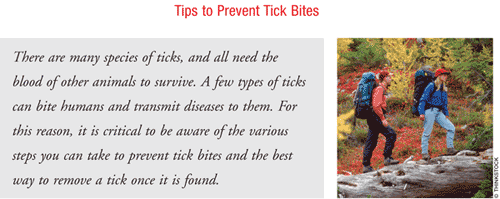
The best advice for preventing tick bites is to simply stay away from their territories, such as forests, woods, and fields. However, this would end such recreational activities as picnicking, hiking, and camping. Thus, the next best advice is to dress in a way that prevents ticks from contacting your skin. The worst clothing choices are shorts, sandals, and other apparel that bares the skin. It is better to wear socks and shoes that cover the entire foot and jeans or slacks with long legs. Wear shirts with long sleeves that are solid from shoulder to wrist, and button the sleeves as tightly as possible. Cover the hands with gloves. Now the skin is shielded, but ticks can still gain access by crawling up a pants leg or a sleeve.
To stop ticks, it is important to seal access points. Tuck the pants legs into socks and use duct tape to seal the junction, if possible. Use more duct tape to seal the glove-sleeve juncture. Finally, use duct tape to seal the place where the shirt is tucked tightly into the pants waist. Button the shirt to the top button. Wear a hat. Occasionally, if the pants and shoes are light in color, examine them to see if ticks are crawling up to gain access. Brush ticks off and have a partner check your back for any crawling invaders.
Using Tick Repellents
There are a variety of insect repellents available for personal use. The most common product is DEET, found in sprays, pumps, wipes, and lotions (e.g., OFF!, Cutter, Repel). Picaridin is also a safe choice (e.g., Skin-So-Soft).
Inspecting for Ticks
After you return home, it is important to conduct a full body inspection to detect ticks. People have found ticks in the most unlikely locations, such as inside the ears, in the hair, inside the vagina, and in the eyelids. You must examine every possible part of your skin. Use a mirror to see spots you cannot visualize directly. Have someone else check your hair, back, etc.
Removing Ticks
It is critical to carry out the tick inspection and remove the arthropods immediately, because studies show that the risk of getting a disease from an infected tick is far higher if the tick is able to stay on you and suck your blood for more than 24 hours. Ticks remain on you for an average of 29 hours, but may stay for more than 48 hours. Your goal should be to remove them as quickly as possible, but certainly before 24 hours have passed. To remove the tick, grasp it near its head with tweezers, and pull steadily upwards. When the tick releases its hold, it can be removed and placed in a jar, labeled with the date of removal and the area where it was likely caught. If you develop symptoms later, having the tick can speed a diagnosis.
Remember, if you have questions, Consult Your Pharmacist.
REFERENCES
1. Pray WS. Nonprescription Product Therapeutics. 2nd ed. Baltimore, MD: Lippincott Williams & Wilkins; 2006.
2. Rocky mountain spotted fever (RMSF). CDC. www.cdc.gov/rmsf/. Accessed June 25, 2012.
3. Lyme disease. CDC. www.cdc.gov/lyme/. Accessed June 25, 2012.
4. Anaplasmosis. CDC. www.cdc.gov/anaplasmosis/. Accessed June 25, 2012.
5. Parasites—Babesiosis. CDC. www.cdc.gov/parasites/babesiosis/. Accessed June 25, 2012.
6. Ehrlichiosis. CDC. www.cdc.gov/ehrlichiosis/. Accessed June 25, 2012.
7. Ehrlichiosis. PubMed Health. www.ncbi.nlm.nih.gov/pubmedhealth/PMH0002357/. Accessed June 25, 2012.
8. Southern tick-associated rash illness. CDC. www.cdc.gov/stari. Accessed June 25, 2012.
9. Tick-borne relapsing fever. CDC. www.cdc.gov/relapsing-fever/. Accessed June 25, 2012.
10. Tularemia. CDC. www.cdc.gov/tularemia/. Accessed June 25, 2012.
11. Insect repellents: EPA registered vs. unregistered
pesticides. Environmental Protection Agency (EPA).
http://epa.gov/pesticides/insect/registered_unregistered.htm. Accessed
June 25, 2012.
12. The insect repellent DEET. EPA. www.epa.gov/pesticides/factsheets/chemicals/deet.htm. Accessed June 25, 2012.
13. DEET: Health effects in humans. Agency for Toxic
Substances and Disease Registry.
www.atsdr.cdc.gov/consultations/deet/health-effects.html. Accessed June
25, 2012.
14. Using insect repellents safely. EPA. http://epa.gov/pesticides/insect/safe.htm. Accessed June 25, 2012.
15. New pesticide fact sheet: picaridin. EPA. www.epa.gov/opprd001/factsheets/picaridin.pdf. Accessed June 25, 2012.
16. Active ingredients found in insect repellents. EPA.
www.epa.gov/pesticides/health/mosquitoes/ai_insectrp.htm. Accessed June
25, 2012.
17. Off! Clip-On. S.C. Johnson & Son, Inc.
www.keepsbugsoff.com/en-US/Products/Pages/off-clip-on.aspx#off-clip-on-mosquito-repellent.
Accessed June 25, 2012.
18. Citronella (oil of citronella) (021901) fact sheet.
EPA.
www.epa.gov/pesticides/biopesticides/ingredients/factsheets/factsheet_021901.htm.
Accessed June 25, 2012.
19. Minimum risk pesticides. EPA. www.epa.gov/oppbppd1/biopesticides/regtools/25b_list.htm. Accessed June 25, 2012.
To comment on this article, contact rdavidson@uspharmacist.com.