US Pharm. 2013;38(1):9-12.
Patients sometimes ask pharmacists about troubling symptoms such as dizziness or hearing loss. A pharmacist who is aware of the possible causes of these symptoms may be able to recognize the onset of Meniere’s disease.
Prevalence of Meniere’s Disease
According to the National Institute on Deafness and Other Communication Disorders (NIDCD), approximately 615,000 adults have been diagnosed with Meniere’s in the United States, but at least 45,000 to 100,000 new cases are diagnosed each year.1,2 However, other authorities quote the prevalence rates in the U.S. to vary from as few as 3.5 patients per 100,000 to as many as 513 per 100,000.3
Epidemiology
The onset of Meniere’s can be felt at any age. However, the primary ages of attack are between 40 and 60 years, and 10% of those aged 65 years or older have Meniere’s.1,4 There is a female-to-male ratio of 1.89:1.3 Meniere’s may also occur with more frequency in patients who abuse alcohol or tobacco, are stressed or fatigued, and have allergies.1,2
Etiology
At its heart, Meniere’s disease is a malfunction of the inner ear, also referred to as the labyrinth.1 The labyrinth contains the mechanism that provides the sense of hearing, known as the cochlea, and also the organs that facilitate balance, referred to as the semicircular canals and otolith apparatus (e.g., the utricle and saccule).
There are two sections to the labyrinth.1 The first is the bony labyrinth, serving as the walls of the chambers. The second is the membranous labyrinth, a set of thin, pliable tubes and sacs. The tubes and sacs composing the membranous labyrinth are filled with a fluid known as endolymph. Endolymph serves critical purposes in both hearing and balance. As the body undergoes motion, endolymph stimulates receptors that inform the brain that motion has occurred and the direction of that motion. Further, endolymph is compressed when the vibrations of sound impact the eardrum, sending another set of signals to the brain that allow humans to possess normal hearing.
If the quantity of endolymph in the labyrinth is normal, the patient has normal hearing and balance. However in some patients, endolymph can build to abnormal levels, a condition known as endolymphatic hydrops.5 This is the essential etiologic defect behind Meniere’s disease (confirmed through postmortem analysis), as the buildup of fluid interrupts the normal transmission of hearing and balance signals to the brain. This also explains the simultaneous symptomatology of hearing and balance that constitute Meniere’s.
Endolymph buildup serves as an easily understandable explanation for Meniere’s. However, the NIDCD explains that it is only one of a host of etiologic theories. Some researchers have explored the possibility that Meniere’s might be caused by the same vasoconstriction that also causes migraine headaches.1 Others have examined the roles of infection of the middle and inner ear, systemic viral infection, respiratory infection, or cranial injury.1,2 Some patients may experience Meniere’s as a result of autoimmune diseases or a genetic tendency to overproduce endolymph, since it appears in families.
Manifestations of Meniere’s Disease
Some patients experience a full-blown attack of Meniere’s vertigo without warning. Others report that a peculiar set of symptoms heralds the vertiginous attack. These patients experience a sensation of ringing, most often in only one ear.1 They may also notice that the hearing in that ear begins to have a muffled quality. Perhaps they notice a feeling of fullness, pressure, or congestion in the ear.
Whether patients notice the warning signs or not, all suffer the dizziness or vertigo that helps define Meniere’s. The vertigo can be of sudden onset and severe, so that patients lose their balance and immediately fall, a phenomenon known as the drop attack.1 It can last for as little as 20 minutes or as long as several hours. Vertigo and dizziness may, in turn, bring about nausea and/or vomiting. Patients also complain of sweating, headaches, diarrhea, abdominal pain and/or discomfort, and uncontrollable nystagmus.
Patients may experience occasional attacks punctuated by long periods of normalcy. Others experience an initial attack, but suffer numerous recurrences over the next several days.1 The hearing loss that accompanies Meniere’s is initially a low-frequency loss. Although hearing seems to return to normal between attacks, most patients experience a slow worsening of their hearing, so that it never again reaches the pre-Meniere’s level.
Physician Diagnosis of Meniere’s
When the pharmacist suspects the presence of Meniere’s, it is vital to refer the patient to a physician. The most appropriate physicians are board-certified otolaryngologists, because they have specific training in diagnosis and treatment. As there is no test that can conclusively identify Meniere’s, physicians ask whether the patient has experienced: 1) two or more episodes of vertigo that lasted at least 20 minutes, 2) tinnitus, 3) a temporary loss of hearing, and 4) a feeling of fullness in the ear. The physician may order an MRI or CT scan to rule out more serious medical conditions. Even the most sophisticated testing can only confirm the diagnosis in about 66% of those who actually have the condition.6
Treatment of Meniere’s Disease
Physicians can employ several approaches to treat Meniere’s disease.1 However, since the cause of Meniere’s is still unknown, there is no specific cure. Rather, there are several interventions that may provide relief.7
One is to prescribe medications to lessen the dizziness. These include meclizine, diazepam, and lorazepam. Another therapeutic goal is to reduce the amount of endolymph through the use of dietary sodium restriction and diuretics.
Physicians may choose to inject gentamicin into the middle ear (i.e., an intratympanic injection) to assist in controlling vertigo. The danger is the ototoxicity of gentamicin, which can compromise hearing in an ear already vulnerable to hearing loss resulting from the condition itself.8 Because of this danger, some physicians prefer corticosteroids, as they reduce dizziness but do not carry the risk of ototoxicity. Researchers reviewed 13 studies on the use of intratympanic steroids in Meniere’s disease.9 They concluded that the studies to date were insufficient to determine whether this method was efficacious, which steroid would be best, and what the optimal dosing regimen was. However, other researchers injected dexamethasone intratympanically once daily into 22 patients with Meniere’s disease for 5 consecutive days.10 They noted a statistically significant improvement in frequency and severity of vertigo 24 months later.
The FDA has approved a medical device that the patient places into the outer ear. It delivers intermittent pulses of air to the middle ear, apparently acting on endolymphatic fluid to prevent the attacks of dizziness that are characteristic of Meniere’s.1
Surgery is an option when other approaches have been of limited success. One procedure is to sever the vestibular nerve, although a more common approach is decompression of the endolymphatic sac.
Cognitive therapy may be of benefit for some patients.1 In this method, patients discuss how they interpret and react to various experiences in their lives. Some find the process successful in helping them cope with sudden attacks and also find that it reduces their level of anxiety and worry about the future.
Prognosis of Meniere’s
The prognosis for patients with Meniere’s is fairly good. Some patients improve without any special intervention. Approximately 60% of patients will improve if they follow a low-sodium diet, cease use of substances of abuse (caffeine, alcohol, nicotine), and follow their prescribed medication regimen.1 Those who do not respond may become chronically disabled unless they undergo surgical correction.
Special Challenges of Bilateral Meniere’s
In most cases, only one ear is affected by Meniere’s.1 However, the unilateral condition may evolve into the more rare bilateral variant.11 Several new techniques can predict which patients will develop bilaterality, in which case techniques that destroy the vestibular nerve are contraindicated due to the risks of destruction of hearing and sense of balance.
Atmospheric Pressure Changes
As with most medical conditions, there are numerous Web sites and blogs that offer advice about Meniere’s disease. A surprising number of patients mention that they are affected by atmospheric pressure changes. They complain that rapid and drastic changes in weather cause the attacks. There is a dearth of support in the medical literature for this observation, however, making this a fertile field for research. Perhaps pharmacists could advise patients to take extra care during adverse weather conditions if they noticed an association between weather and Meniere’s.
Role of Alternative Medicine
According to the NIDCD, a smattering of research with alternative medical approaches has failed to demonstrate that any are efficacious.1 The list of ineffective methods includes acupressure, acupuncture, tai chi, niacin, and herbal supplements such as gingko and ginger root. Patients who ask for information about these unproven methods should be strongly urged to abandon them and seek legitimate medical care.
PATIENT INFORMATION
Common Symptoms of Meniere’s Disease
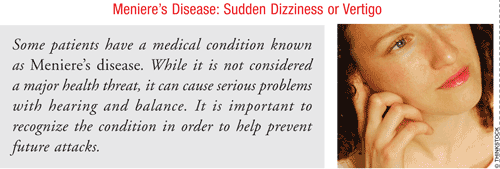
The most dangerous aspect of an acute attack of Meniere’s disease is a sudden dizziness or vertigo that can endanger your life. If you are driving when this hits, you may be forced to brake and steer with great care to the side of the road. If you are standing, you may be unable to balance and suddenly fall to the ground. You may also notice a loss of hearing in one or both ears, ringing or roaring in the ears, and/or a feeling of fullness in the ears. Perhaps you experience nausea and/or vomiting during an attack.
Enlist Family Support
Make sure that your friends and family are aware of your condition. Inform them that you may lose your balance with little warning, and that they should be ready at any time to support your body and help you walk to a safe location.
During an Attack
The dizziness and loss of balance you feel during an episode of Meniere’s should cause you to take great care. First, reach a safe location where you can lie down and will not fall and injure yourself. This should be a firm, nonmoving surface. A water bed would not be appropriate. Try to move as little as possible while the attack is in progress. Any sudden movement can worsen the attack and make you even dizzier. You may find it helpful to lie in a dark room to minimize visual stimulation that could prolong the attack, but do not gaze at a twirling ceiling fan. During the attack, do not read, play video games, or watch television. If you must move during an active attack, enlist your family to assist you.
After an Attack
After you have recovered from the incident, you may still be prone to further attacks. Increase your activity level gradually to see if you are still symptom free. To increase your safety, do not drive, operate dangerous machinery, or engage in hazardous outdoor activities such as climbing until at least one week has passed. A sudden attack during these activities could endanger your life.
Seeing Your Physician
As soon as is practical, make an appointment with a physician. A board-certified otolaryngologist (ear, nose, and throat [ENT] doctor) is the best choice. Your physician will explore such issues as the symptoms and type of attack you experienced, any triggers that may have brought it about, and your other medical conditions. Tests may be required, and your physician may choose to recommend prescription medications (e.g., antiemetics). Follow the directions and take them exactly as advised by your pharmacist and physician. You may be instructed to alter your diet to lower your sodium intake. You may also be able to minimize attacks by ceasing use of caffeinated beverages and alcohol and by quitting smoking.
Remember, if you have questions, Consult Your Pharmacist.
REFERENCES
1. Meniere’s disease. National Institute on Deafness and
Other Communication Disorders.
www.nidcd.nih.gov/health/balance/pages/meniere.aspx. Accessed November
23, 2012.
2. Meniere’s disease. PubMed Health. www.ncbi.nlm.nih.gov/pubmedhealth/PMH0001721/. Accessed November 23, 2012.
3. Alexander TH, Harris P. Current epidemiology of Meniere’s syndrome. Otolaryngol Clin North Am. 2010;43:965-970.
4. Vibert D, Caversaccio M, Häusler R. Meniere’s disease in the elderly. Otolaryngol Clin North Am. 2010;43:1041-1046.
5. Semann MT, Megerian CA. Contemporary perspectives on the pathophysiology of Meniere’s disease: implications for treatment. Curr Opin Otolaryngol Head Neck Surg. 2010;18:392-398.
6. Adams ME, Heidenreich KD, Kileny PR. Audiovestibular testing in patients with Meniere’s disease. Otolaryngol Clin North Am. 2010;43:995-1009.
7. Greenberg SL, Nedzelski JM. Medical and noninvasive therapy for Meniere’s disease. Otolaryngol Clin North Am. 2010;43:1081-90.
8. Pullens B, van Benthem PP. Intratympanic gentamicin for Meniere’s disease or syndrome. Cochrane Database Syst Reviews. 2011;(3):CD008234.
9. Hu A, Parnes LS. Intratympanic steroids for inner ear disorders: a review. Audiol Neurootol. 2009;14:373-382.
10. Phillips JS, Westerberg G. Intratympanic steroids for Meniere’s disease or syndrome. Cochrane Database Syst Reviews. 2011;(7):CD008514.
11. Nabi S, Parnes LS. Bilateral Meniere’s disease. Curr Opin Otolaryngol Head Neck Surg. 2009;17:356-362.
To comment on this article, contact rdavidson@uspharmacist.com.