US Pharm. 2012;37(10):12-15.
Pharmacists routinely recommend nonprescription products for active treatment of a host of specific medical conditions (e.g., headache, tinea pedis, allergic rhinitis).1 However, in a few instances, pharmacists can provide valuable advice about preventing medical problems through the use of OTC products and devices. Preventive products sold by pharmacists include sunscreens to prevent skin cancer.
Another major group of preventive products maintain and improve oral health, specifically by fighting caries and gingivitis. Manufacturers market thousands of different devices and products for these purposes. The consumer is bombarded with advertisements for toothpastes, toothbrushes, powered cleaning devices, etc. These ads seldom present a coherent overall strategy for maintaining oral health. For this reason, when consumers ask the pharmacist about oral cleansing products, it is prudent to ask whether a dentist has recommended those products. If not, the pharmacist should next ask the consumer if he or she keeps regular appointments for dental checkups and cleanings. If the patient does not see a dentist regularly, the pharmacist should stress the value of doing so, in order that the patient may obtain the best advice on an overall dental care program.
How Plaque Becomes Tartar
Each human body contains millions of organisms, collectively referred to as the microbiome.2 The oral cavity is no exception. Within a few minutes of complete dental cleansing, a sterile film known as the pellicle forms on all surfaces.1 During the day, the microbiome inside the mouth (primarily gram-positive cocci) adheres to the pellicle, proliferating to form plaque.3 The intraoral surfaces in this process are no different from an agar-filled Petri dish inoculated with bacteria and placed in an incubating oven, with the tooth surfaces taking the place of the Petri dish.
Plaque is a gel-like material that can easily be removed by the patient with proper attention. However, millions of patients do not undertake proper tooth care, so that the plaque remains present for considerable periods. If it is not removed, it can lead to caries (i.e., cavities), a disorder that is second in incidence only to the common cold.3,4 Further, by day 3 or 4, filamentous organisms infiltrate the plaque, producing calcium phosphate and depositing it on tooth surfaces. This is calculus (tartar), and safe and thorough removal of this rock-like material requires a dental appointment and the services of a dental hygienist. Thus, the patient must constantly strive to remove plaque before it morphs into tartar.
Tartar can extend below the gumline, destroying the periodontal ligament that attaches teeth to the adjacent, surrounding alveolar bone (i.e., the tooth socket). If this process is not arrested, ligamental destruction becomes so pervasive that tooth mobility is inevitable.5,6 Tooth mobility leads in many cases to tooth loss.
Oral care products should remove dental plaque when used properly. Dental care professionals stress that there are three cornerstones to home dental care: toothbrushing, flossing, and using a periodontal aid.5
Toothbrushing
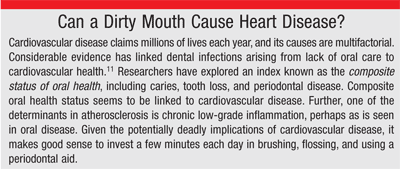
Toothbrushing is mandatory to disrupt plaque, and it is the most common oral care activity the average American undertakes.7 Some people brush too seldom (e.g., only once or twice weekly) and others do it poorly, neglecting such areas as the inside surfaces of the teeth and the back molars. Patients whose brushing habits are suspect should be referred to a dentist for appropriate advice on brushing frequency and techniques. If a dentist has recommended a specific brand of brush or dentifrice, the pharmacist can point it out and answer any questions remaining from the dental visit.
If it becomes clear that the patient will not seek dental care, the pharmacist should at the very least suggest that the patient clean the teeth with a soft-bristle brush and a reputable brand of fluoridated toothpaste twice daily, in conjunction with daily flossing and the daily use of a periodontal aid. The pharmacist can also suggest that the patient search the Internet for diagrams that demonstrate optimal toothbrushing methods. This is not a fully acceptable substitute for a dentist visit, but it is better than letting patients guess at optimal cleaning methods.
Patients may ask about the efficacy of “tartar control” toothpastes. The manufacturers of these products were never able to prove that they actually accomplish removal of hardened calculus, and the FDA finally decided to consider them cosmetic products only.1
Flossing
Daily flossing is as critical as brushing, in that it cleans plaque that is not removed by brushing alone.8 However, surveys reveal that most people do not floss.1 Some are uninformed about its benefits, others may have initiated flossing but failed to establish a routine, and some simply refuse to consider flossing. If these patients do speak to the pharmacist, it is important to stress the value of flossing and refer them to a dentist for further information. A final group of patients may have tried flossing at one time but were unable to do it successfully, although they still have a desire to floss. Pharmacists can make a great impact on the oral health of this group through knowledge of the common problems encountered in flossing and the method(s) to counter them.
Patients who have been unsuccessful in flossing usually have encountered several common problems that can be overcome. One is floss that shreds or breaks. This is common when the teeth are extremely tight against each other. Patients may find that switching to waxed floss (e.g., Reach Waxed Floss) or dental tape (e.g., Oral-B Satintape) will solve the problem. Another option is the use of nonshred floss (e.g., Glide Pro-Health Floss). Some patients cannot manage the standard two-handed flossing method. They may have the use of only one hand due to a stroke or amputation. In this case, they may be able to use such flossing accessories as prethreaded forks (e.g., GUM Eez-Thru Flossers, Oral-B Floss Picks) or forklike devices that can be threaded with one hand (e.g., GUM Flossmate).1
Periodontal Cleansing
Periodontal cleansing aids are the third cornerstone of dental and gingival health. Patients should carry out thorough periodontal cleansing once daily, using a device that does not harm the teeth or gums. Wooden devices (e.g., Stim-U-Dent) are straight and nonflexible, making it exceedingly difficult to remove plaque from inner (lingual) areas or the back molars. Rubber devices and flexible plastic picks may not effectively remove plaque, and metal scrapers can damage enamel and gums.
Perio-Aid #2 is a safe and effective periodontal cleansing device that can be obtained through certain dentists.1 The patient inserts a toothpick into a plastic handle, breaking it off at a 90-degree angle. Then the end of the toothpick is run around all spots where the teeth and gums meet (the gingival sulcus), removing plaque before it converts to tartar.
Fluoridated Mouthwash
The use of fluoridated mouthwashes may be necessary for some people, especially if the patient lives in a city where fluoride is not added to water, or in a rural area where well water does not contain sufficient fluoride.9,10 These mouthwashes can also be helpful for patients who decline to drink fluoridated city water or prefer nonfluoridated bottled water. Fluoridated mouthwashes include such products as ACT Anticavity Fluoride Rinse, Colgate Phos-Flur, Colgate Plax, Listerine Tooth Defense, and Listerine Smart Rinse. Patients are advised to use the mouthwash once daily after brushing, swishing 10 mL around the mouth and between the teeth for one minute before expectorating it. Patients should not eat or drink for 30 minutes to allow better binding of the fluoride to the tooth enamel.
To prevent excess fluoride (i.e., dental fluorosis), fluoridated mouthwashes carry age limits against unsupervised use in those too young to understand the requirement not to swallow the liquid. Those aged 6 to 12 years should use the products only with adult supervision, and those under the age of 6 years should not use them without a specific recommendation from a dentist or physician.
Plaque Preventives
Several ingredients are proven to reduce or prevent plaque and gingivitis. One is cetylpyridinium chloride, found in Cepacol Antibacterial Mouthwash. Patients aged ≥12 years should vigorously swish 20 mL around the mouth and between the teeth for 30 seconds each day and then expectorate. Those aged 6 to under 12 years should be supervised in its use, and the product should not be used in those under the age of 6 years.1
Another plaque preventive is a mixture of eucalyptol 0.092%, menthol 0.042%, methyl salicylate 0.060%, and thymol 0.064%. Listerine is a proprietary product containing this mixture. Patients should rinse full strength for 30 seconds with 20 mL of solution morning and night before expectorating.
Patients should not use plaque preventives if gingivitis, bleeding, or redness persists for more than 2 weeks, or if there are any of these signs of periodontitis: painful or swollen gingiva, pus issuing from the gumline, loose teeth, or increasing space between the teeth.
Plaque-Disclosing Agents
Patients who visit dentists are familiar with the process of swishing a colored dye solution around the mouth and expectorating. The dye preferentially adheres to and stains plaque. The dental team checks for these uncleaned areas and instructs the patient to try to pay attention to them. Patients may wish to purchase home disclosing agents to check their own cleaning regimen between dental checkups. Disclosing agents include GUM Red-Cote, Inspector Hector Plaque Detector, and Listerine Agent Cool Blue.1 If patients are unable to cleanse stained areas, they should make an interim dental appointment so that their cleaning regimen can be examined.
Dental Pain
Patients occasionally ask the pharmacist for help with dental pain. Tooth pain can arise from such causes as a cracked tooth, lost filling, sinus infection, tooth abscess, or eroded dental enamel.1 Dental pain requires a referral to discover the cause. If the cause is dental erosion, pain begins when the erosion nears the nerve, causing pulpitis. If the erosion is caught early enough, a restoration may save the tooth. If the patient continues to procrastinate, nerve damage may be irreversible, and the tooth may have to be extracted or subjected to a root canal. Neither of these is preferable to saving a vital tooth. Thus, even though patients may object to the advice, a referral for dental pain is a prudent choice.
PATIENT INFORMATION
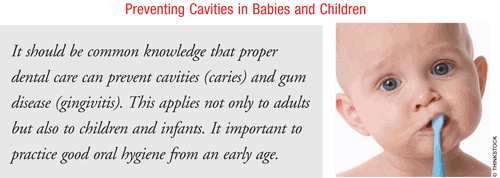
Adults can decide for themselves whether to prevent cavities and gingivitis by proper tooth and gum care, or to be negligent and suffer tooth pain, tooth loss, and gum disease. However, children are dependent on their parents and caregivers to help keep them disease free until they reach a responsible age.
Why Baby Teeth Need Care
Some people unwisely think that baby teeth are not important, as they will be lost in a short time anyway. Children need healthy baby teeth so they can chew food properly, speak words as they should, and keep sufficient space in the mouth for their adult teeth to come in straight.
Foods and Drinks That Cause Decay
The major culprit in cavities and gum disease is sugar. Bacteria use the sugar for food and produce acids that erode the teeth. Breast milk is the healthiest food for babies, as it helps stop bacteria. All sugary foods and drinks promote tooth and gum damage. This includes milk, formula, fruit juices, and sugar-containing baby food. Experts discovered that alternating these sugary drinks with breast milk is actually worse than giving children sugar alone! For this reason, parents should avoid offering sugary foods and drinks as much as possible.
It is also important to watch how long sugary substances remain in the mouth. Giving a child a “sippy cup” or bottle with these products in it allows greater exposure over the course of the day. Giving a bottle at night that allows a baby to suck while asleep causes cavities in the teeth exposed to the sugar, a condition known as nursing-bottle mouth.
Cavity Prevention in Babies and Children
To prevent cavities in babies and children, follow this advice. For children aged 6 to 12 months, be sure not to put anything in the bottle except formula. Never fill a bottle with sugary fluids (e.g., fruit punch, soft drinks) and never let children walk around with a bottle of juice or milk for a pacifier. Never dip a pacifier in honey, sugar, or syrup. Put children to bed with a bottle containing water and never juice, milk, or formula. After the child is asleep, remove the bottle. Introduce drinking from a cup when the baby is 6 months of age and stop using the bottle when the baby is 12 to 14 months old.
Start tooth care as soon as teeth appear. Remove plaque from baby teeth after each feeding by wiping the teeth and gums gently with a clean washcloth or gauze pad. Wipe infant and toddler teeth with a washcloth with a small amount of nonfluoridated toothpaste on it. When the child is old enough to comply with instructions to spit toothpaste out, switch to fluoridated toothpaste. Start brushing when the child is older and begin flossing when all of the baby teeth are in place (around 2½ years of age). At 6 months of age, start fluoridated water or fluoride supplements. Use bottled water only if it has fluoride. Start dental visits by age 2 or 3 years or earlier if all of the baby teeth are in place.
Remember, if you have questions, Consult Your Pharmacist.
REFERENCES
1. Pray WS. Nonprescription Product Therapeutics. 2nd ed. Baltimore, MD: Lippincott Williams & Wilkins; 2006.
2. Zarco MF, Vess TJ, Ginsburg GS. The oral microbiome in
health and disease and the potential impact on personalized dental
medicine. Oral Dis. 2012;18:109-120.
3. Dental cavities. MedlinePlus. www.nlm.nih.gov/medlineplus/ency/article/001055.htm. Accessed August 26, 2012.
4. Forssten SD, Björklund M, Ouwehand AC. Streptococcus mutans, caries and simulation models. Nutrients. 2010;2:290-298.
5. Gingivitis. MedlinePlus. www.nlm.nih.gov/medlineplus/ency/article/001056.htm. Accessed August 26, 2012.
6. Seneviratne CJ, Zhang CF, Samaranayake LP. Dental plaque biofilm in oral health and disease. Chin J Dent Rsch. 2011;14:87-94.
7. Davies R, Scully C, Preston AJ. Dentifrices—an update. Medicina Oral Patolog Cirug Bucal. 2010;15:e976-e982.
8. Sambunjak D, Nickerson JW, Poklepovic T, et al.
Flossing for the management of periodontal diseases and dental caries in
adults. Cochrane Database Syst Rev. 2011;(12):CD008829.
9. Pessan JP, Toumba KJ, Buzalaf MA. Topical use of fluorides for caries control. Monograph Oral Sci. 2011;22:115-132.
10. Demke R. Plaque inhibition: the science and association of oral rinses. Dent Today. 2012;32:96-101.
11. Cotti E, Dessì C, Piras A, Mercuro G. Can a chronic
dental infection be considered a cause of cardiovascular disease? A
review of the literature. Intl J Cardiol. 2011;148:4-10.
To comment on this article, contact rdavidson@uspharmacist.com.